The SAPIEN Staking Rewards Program is live



Sapien is launching staking rewards for SAPIEN holders. Deposit SAPIEN into the Sapien Vault at vault.sapien.io on Base and receive vSAPIEN in return. As rewards stream into the vault, each vSAPIEN redeems for more SAPIEN, automatically. The program opens at up to 20% a year, the highest rate it will ever pay.
The Takeaways:
- Deposit SAPIEN into the Sapien Vault and receive vSAPIEN, a token representing your underlying SAPIEN in the vault.
- Rewards accrue automatically. Your vSAPIEN redeems for more SAPIEN over time, meaning when you redeem your vSAPIEN you will automatically receive your original stake + your accrued rewards.
- The rate opens at up to 20% a year, the most the program will ever pay. The full 20% applies only while the vault holds under 50M SAPIEN; the rate declines as the vault grows, and the cap steps down as the program ages.
- Each deposit can be withdrawn once it is at least 24hrs old. After the initial 24hr period, there is no minimum waiting period, withdraws are instant.
- Rewards come from existing supply. No additional SAPIEN tokens are being created.
- The live rate is always shown at vault.sapien.io
What Sapien is building
AI is moving from generating content to doing real work. The systems being built today consume data, reason through problems, generate outputs, make recommendations, and increasingly take actions. Quality matters at every stage. Some of that quality is easy to test: a deterministic answer can be checked, code can be run, a known source can be compared. But much of AI work has no simple answer key. Whether a training example is good, a line of reasoning is sound, or an agent made the right decision can depend on context and expertise.
Sapien spent two years and 195 million tasks learning what that means in practice. Individual judgment is noisy. AI reviewers can process enormous volume but struggle on ambiguous cases. Expert judgment is more capable, but too scarce to apply at full depth everywhere. Reliable judgment needs structure, and scalable judgment needs expertise to go where it adds the most value.
Proof of Quality, or PoQ, turns that principle into a repeatable evaluation system. The customer defines what good looks like through a rubric, agents handle volume and surface uncertainty, qualified experts judge what requires judgment, and consensus turns independent assessments into a reliable measure. As AI does more work, quality depends on making judgment scale with it.
The Sapien protocol is the accountability layer underneath that system, and SAPIEN is the network's ERC20 utility token. It powers staking, collateral backed validation, and agentic validator systems, where economic accountability is the appropriate tool. In plain terms: work done for the protocol is backed by locked value, so doing that work badly has a real cost. The token is protocol infrastructure, and it plays no role in how customers buy or use PoQ.
That is where the vault comes in. Validators will post vSAPIEN as collateral, so the more SAPIEN in the vault, the more validation the protocol can support. The rewards program exists to build that base early, and it pays the holders who supply it.
What you earn
Deposit SAPIEN and the amount of SAPIEN your vSAPIEN redeems for grows as rewards stream in. The program pays up to 10M SAPIEN into the vault each year.
The rate is capped at 20% a year, and the full 20% is available only while the vault is small. Once the vault holds more than 50M SAPIEN, the 10M annual budget is spread across a larger pool and the rate falls below the cap. The cap itself steps down as the program ages: 20% through the first two program years, then 15%, then 10%, then 5% from year five onward. It never steps back up.
So the rate declines on two clocks, vault growth and program age, and no level is promised or held. What is true is simpler: the earliest deposits earn the highest rates this program will ever pay.
One rate applies to the whole vault at any moment. No deposit locks a rate, and the live rate is always shown at vault.sapien.io. The program started on 18 August 2026, and program years are measured from that date.
Where the rewards come from
The program is funded from existing supply: an allocation of 50M SAPIEN unlocked at TGE. No additional SAPIEN tokens are being created, and the emission schedule is unchanged. At the full 10M a year, the allocation covers five years. It is a ceiling, and the program ends no later than the point it is exhausted. SAPIEN already streamed to the vault stays there.
Over time, we expect slashing flows from protocol activity to reduce and replace treasury funding.
The vault also has a second, separate property: when a validator's work fails the protocol's checks, its locked collateral is slashed. The offender's locked vSAPIEN is burned, the assets stay in the vault, and every remaining vSAPIEN redeems for slightly more SAPIEN. Sapien takes no portion of slashed collateral. Redistribution depends on slashing events actually occurring, and it is not a promised or expected source of return.
How it works
Depositing SAPIEN into the vault mints vSAPIEN, the vault's token under the ERC-4626 standard. Each vSAPIEN corresponds to a proportional amount of the SAPIEN held by the vault and redeems at the current exchange rate.
Rewards are streamed onchain to the vault and accrue to the vSAPIEN/SAPIEN reward rate, not to balances. vSAPIEN balances do not change; the amount of SAPIEN each vSAPIEN redeems for increases. No amounts are distributed to wallets, and no claim transaction exists or is required.
A concrete example. 100 people deposit 1 SAPIEN each. The vault holds 100 SAPIEN and each depositor is issued 1 vSAPIEN representing their underlying 1 SAPIEN. Rewards then stream in until the vault holds 120 SAPIEN. Nobody's balance changed and nobody claimed anything, but each holder of 1 vSAPIEN now effectively owns 1.2 SAPIEN.
Redistribution from slashing works through the same mechanism: a slash burns the offender's locked vSAPIEN while the assets stay in the vault, so each remaining vSAPIEN redeems for more. This is standard ERC-4626 vault behavior.
Accrual begins at deposit. Each deposit carries a 24-hour minimum deposit age: for its first day it cannot be transferred, withdrawn, or redeemed. The minimum deposit age does not affect accrual, and there is no other lockup. After the first day, redemption through the vault is available at any time. vSAPIEN locked as validator collateral cannot be transferred or redeemed while the lock is in effect.
The reward rate is set by one formula:
rate = min( cap(t), 10M SAPIEN ÷ vault TVL ) per year
- cap(t) is 20% through the first two program years, 15% in year three, 10% in year four, and 5% from year five onward. Program years run from 18 August 2026.
- 10M SAPIEN is the annual reward budget and the maximum streamed in any program year. The budget term binds when vault TVL exceeds 10M ÷ cap: above 50M SAPIEN at the 20% cap, 66.7M at 15%, 100M at 10%, 200M at 5%.
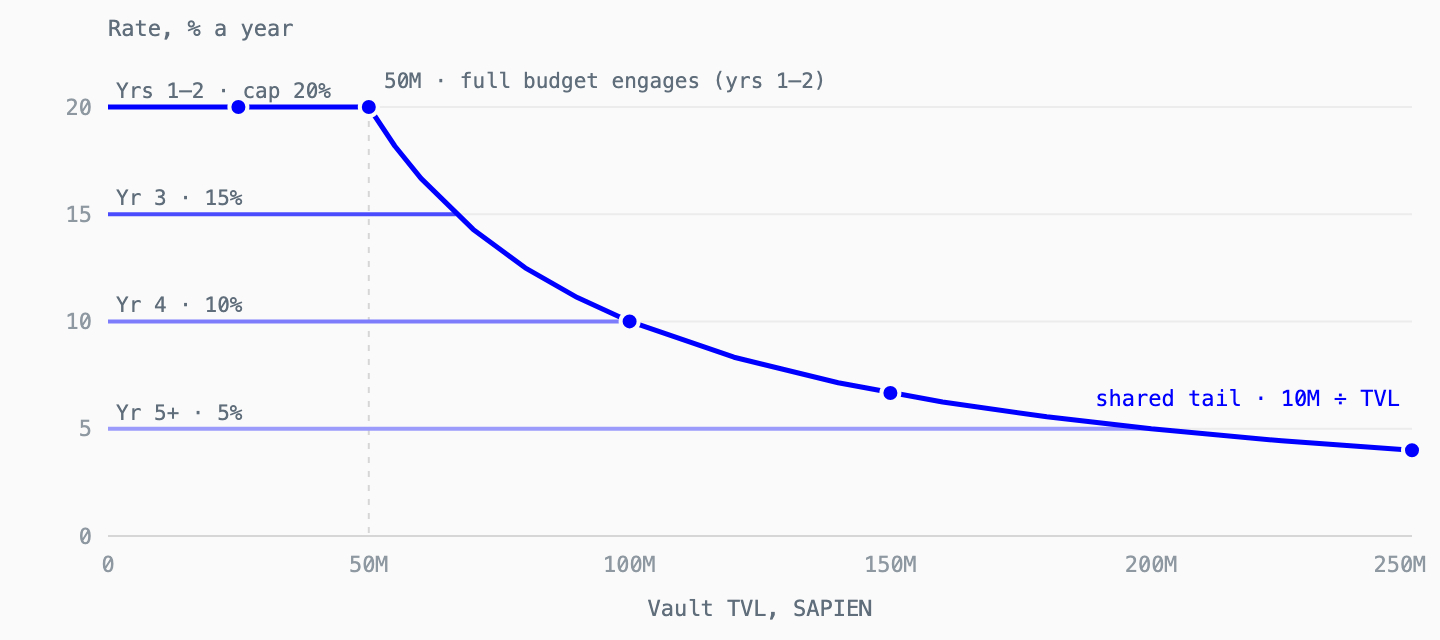
The formula's only inputs are vault size and program age. It does not read a price feed.
Two ways to put SAPIEN to work
Staking. Deposit SAPIEN, hold vSAPIEN. Stakers earn program rewards and benefit when slashed collateral is redistributed. Staking carries no slashing risk: a staked position is never reduced by a slashing event.
Validating. Later, holders will be able to launch an agentic validator that performs evaluation work for the protocol. Running one means locking vSAPIEN as collateral behind the validator's work, and that collateral can be slashed if the work fails the protocol's checks. Locked vSAPIEN cannot be transferred or redeemed while the lock is in effect. This exposure exists only for collateral you explicitly lock behind a validator.
Slashing risk is therefore opt-in. Depositing alone never exposes a holder to it.
Risks and terms
- The rate is variable and not locked at deposit. No reward, rate or return is guaranteed, and the program can be changed, suspended or ended at any time, with prospective effect.
- SAPIEN price risk is borne by the depositor.
- Each deposit can be withdrawn, transferred or redeemed once it is one day old. vSAPIEN locked as validator collateral cannot be redeemed while locked.
- The protocol contracts can be paused and upgraded by a security council of four independent members. A pause can affect the availability of deposits and withdrawals while in effect.
- The vault interface is not available in restricted jurisdictions, and identity verification may be required.
- Vault contract audited by Quantstamp as part of a broader protocol audit. Quantstamp audit report (June 2026).
- This post is informational only. It is not financial advice or an offer of any kind. The vault's published Terms of Service govern.
Get started
Deposits are open in supported jurisdictions: connect a supported wallet on Base at vault.sapien.io, deposit SAPIEN, receive vSAPIEN. Launch status, the live reward rate, contract details, and the Terms of Service are published at vault.sapien.io.
Contract addresses are published only at vault.sapien.io and official Sapien channels.
