Why Every AI Generated Document Needs Independent Verification



Any language model can invent something that reads like a legal authority in seconds. Verifying that authority may require finding the official judgment, reading the relevant passage, checking its procedural context, and deciding whether it supports the argument attached to it.
That imbalance explains much of the current hallucination problem. AI makes document production faster while leaving verification expensive and fragmented. Proof of Quality addresses that gap.
The Takeaways:
- AI hallucinations gain credibility through documents. A fabricated source inside a filing, policy report, expert declaration, or research paper can influence real decisions before anyone checks the underlying evidence.
- Professional authority often substitutes for visible review evidence. Readers see a respected institution, formal language, and an approved final document. They rarely see which claims received verification.
- The hardest to spot errors mix truth with invention. A real case may carry a false quotation. A genuine paper may appear under a fabricated title. A valid source may support a weaker claim than the document attributes to it.
- Proof of Quality creates evidence for the data review process through a rubric, independent review, consensus, and a Proof Report.
Hallucinations Gain Credibility Through Documents
A hallucination inside a private chat is usually easy to discard. The same statement acquires very different weight once it appears inside a professional document, where it begins to influence official decisions that may have consequences down the road.
The difference comes from the role documents play inside institutions. Professional reports inherit authority from the organizations and people who produce them, encouraging readers to accept the conclusion before tracing every claim back to its source. Whether the document is a court filing, a government report, or an expert review matters less than the expectation it creates: someone has already done the verification.
That expectation exists for a practical reason. Modern institutions depend on specialization, and many rely on advisers to investigate questions they lack the time or expertise to examine themselves. Authority therefore rests as much on the review process as on the document itself.
Generative AI changes that relationship. It can reproduce the structure of professional reasoning without performing the investigative work that structure traditionally reflects. A document may therefore look finished while the evidence beneath it remains only partially examined.
Fluency Creates the Wrong Kind of Confidence
People rarely accept AI hallucinations through carelessness alone. They accept them since the signals that usually indicate careful professional work become less reliable once AI can reproduce them at scale.
Fluent language has long served as a practical shortcut for judging expertise. Writers who understand a subject generally organize ideas clearly, use consistent terminology, and connect claims to supporting evidence. Generative AI reproduces those patterns convincingly even when its underlying reasoning remains unsound.
That changes how reviewers behave. Once a document resembles competent professional work, they shift from verifying every important claim toward sampling the evidence and checking for obvious defects.
The strongest hallucinations exploit exactly that weakness. Rather than inventing an entire body of evidence, they preserve enough genuine material to appear authentic while altering the details that determine whether a claim is actually supported. A citation may exist, though the quoted passage does not.
The White House Health Report and the Appearance of Scientific Grounding
Policy documents influence decisions long before most readers examine the evidence underneath them. Their authority comes from the institution publishing them, which encourages readers to accept the supporting research as already verified. That assumption works only when the review process tests every important claim against its original source rather than treating the reference list as evidence in itself.
The 2025 Make America Healthy Again Commission report illustrates what happens when that distinction breaks down. The report relied on hundreds of scientific references to support recommendations on childhood health, yet later investigations identified broken links, incorrect citation details, repeated references, and apparent studies that could not be located. The administration later revised the report while maintaining that its central conclusions remained unchanged.
Those corrections do not settle the underlying problem. A fabricated citation does not automatically invalidate every recommendation in a report, though it removes the evidence readers were asked to rely upon when evaluating those recommendations. Once that chain breaks, confidence shifts from documented support to institutional reputation.
The review process therefore has to verify relationships rather than documents. Every important claim needs an identifiable source, every source must exist, and every source must actually support the statement attached to it. Without that chain, a bibliography becomes a symbol of evidence instead of evidence itself.
Running a Government on hallucinated Information
Independent reviews derive their value from the credibility of their evaluation process rather than the reputation of the organization producing them. When a consultancy is hired to assess government systems, the client expects the same discipline to govern the report itself. The evidence supporting the conclusions therefore becomes part of the product, not merely supporting material.
That expectation became difficult to sustain after problems emerged in Deloitte Australia’s 2025 review of the Targeted Compliance Framework. Researchers later identified fabricated academic references together with a quotation incorrectly attributed to a Federal Court judgment. Deloitte corrected the report, disclosed its use of Azure OpenAI during preparation, and agreed to repay the final instalment of its contract.
The important failure was not simply that incorrect citations appeared. The report had already passed through a professional review process intended to produce reliable advice for government decision making. The missing evidence lay in the review itself. Readers could see the finished conclusions, though they could not determine which claims had been independently verified, how legal authorities had been checked, or whether supporting research had been examined systematically.
That distinction separates document quality from review quality. Correcting a report after publication repairs the text, while it does little to explain how the original failures survived review or how similar failures would be prevented in the future. A defensible review process leaves evidence behind showing how conclusions earned their authority.
Document Review Your Clients Can Verify
AI has changed the economics of review rather than the responsibility for it. Producing a first draft has become dramatically cheaper, while verifying every citation, quotation, legal authority, and supporting claim still demands careful attention. That growing imbalance explains why professional review is becoming the constraint instead of document creation itself.
Proof of Quality approaches the problem by making the review process explicit rather than implicit. Instead of relying on the statement that a document was reviewed, the organization defines what “reviewed” means before work begins. That standard becomes a rubric against which every important claim is evaluated, allowing different reviewers to judge the same work using the same criteria instead of personal habit or intuition.
Independent reviewers then assess the document against that rubric. Where they agree, the review gains stronger evidentiary support. Where they disagree, the disagreement becomes useful information rather than something hidden inside an approval process, revealing the parts of a document that deserve additional scrutiny before anyone signs it.
The final Proof Report captures that process. Rather than asking clients, courts, auditors, or regulators to accept that review occurred, it records what was reviewed, which standard applied, who participated, how consensus was reached, and how the document performed against the organization’s own definition of quality.
The rubric defines quality. The consensus measures it. The record proves it.
A Record for the File
Professional documents inherit authority from the institutions behind them. Readers naturally assume that work published under a government seal, a lawyer’s signature, a consultancy’s name, or a peer reviewed venue has passed through a level of scrutiny proportional to the importance of its conclusions. That assumption has always been reasonable, since producing authoritative work traditionally required substantial human review.
Generative AI changes the balance without changing the expectation. Documents now reach a polished state much earlier in the process, allowing language to outpace verification.
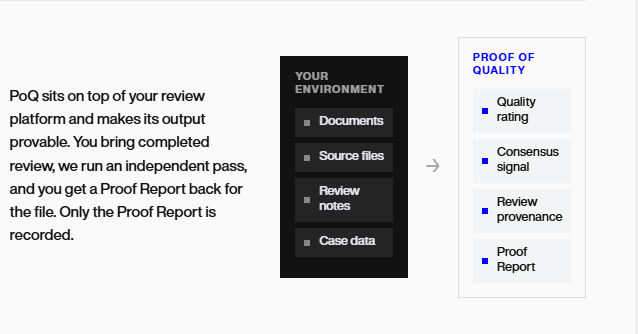
The answer is therefore larger than finding a model that hallucinates less often. Organizations need a review process that produces evidence of its own work. Proof of Quality gives them a way to define that standard, evaluate documents against it, measure independent consensus, and preserve a verifiable record showing how approval was reached.
Most AI quality claims depend on trust. Sapien makes them verifiable.
FAQ
What is an AI hallucination?
An AI hallucination occurs when a model generates information that appears credible but is factually incorrect, unsupported, or entirely fabricated.
Why are AI hallucinations becoming a bigger problem?
AI systems can now produce high-quality drafts in minutes, allowing organizations to generate far more reports, contracts, legal filings, research summaries, and other documents than before. The speed of generation has increased much faster than the speed of verification, leaving review teams responsible for validating far more information than they can realistically examine using traditional workflows.
Why do people trust AI-generated documents?
People generally do not trust AI directly. They trust the institutions and professionals responsible for the document. A report from a respected organization, a signed legal filing, or a professionally prepared analysis carries an expectation that the underlying evidence has already been reviewed. That expectation can remain even when AI performed much of the initial drafting.
How does Proof of Quality help reduce document review risk?
PoQ introduces structure into the review process. Every document is evaluated against a customer defined rubric, independent reviewers assess the work using the same standard, consensus measures the outcome, and a Proof Report records how the evaluation was completed.
How can PoQ help me catch errors?
PoQ allows teams to review labels, demonstrations, trajectories, and evaluations before they enter a model release. Any organization that relies on AI to assist with work to inform important decisions can benefit from a verifiable review process. Wherever AI work influences decisions, the ability to verify how that work was evaluated becomes increasingly valuable.
